Ask a few Drift Boss veterans how they play and a surprising number will tell you the same thing: sound off. The game’s light arcade loop is fine for the first few runs, but somewhere around restart number one hundred most players mute the tab and settle into silence.
Silence isn’t the only option, though. The right track can make a long run feel calmer and your release timing more even. The wrong one, with a sudden drop or a chorus you can’t help singing along to, is a quick way to clip the edge on corner 30. This guide covers what actually works: why drift phonk became the unofficial sound of drifting, how tempo changes the feel of a run, and how to make an original drift track of your own in a couple of minutes.
For record attempts, pick steady instrumentals around 80–110 BPM (lo-fi, mellow synthwave) so the beat calms you instead of rushing you. For short, aggressive sessions, drift phonk (roughly 120–150 BPM) or Eurobeat brings the energy. Skip tracks with big tempo changes or busy vocals. If no playlist fits, generate an original instrumental with an AI music generator and loop it.
Why Music Changes How You Drift
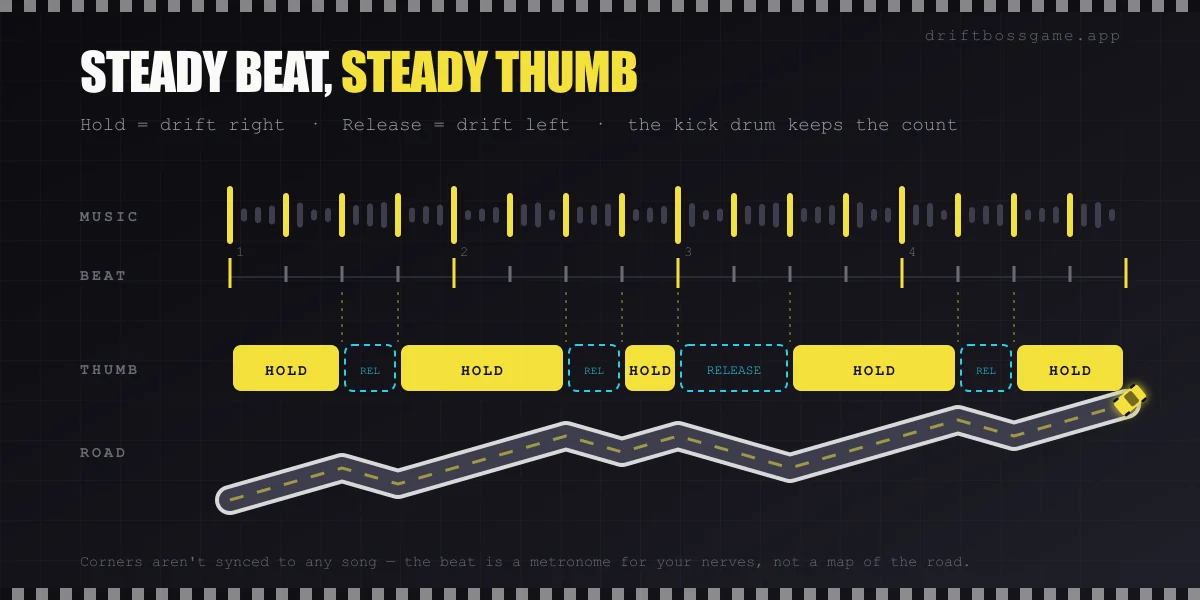
Drift Boss has exactly one input. Hold to drift right, release to drift left, and the car turns at the same rate every time. Speed isn’t the problem. The only thing you control is when you press and when you let go, which makes the game closer to a rhythm game than a racing game.
That’s why music matters more here than in most browser games. A steady kick drum gives your thumb something to count against. You still have to read every corner, because the road isn’t built to any song, but a consistent beat keeps your inputs smooth and cuts down on the panic-tapping that ends most runs.
The flip side is just as true. Tracks with sudden breakdowns, tempo switches or dense lyrics pull your attention off the road at exactly the wrong moment.
Drift Phonk: The Unofficial Sound of Drifting
Spend five minutes watching drift edits on TikTok or YouTube and you’ll keep hearing the same thing: a cowbell melody, distorted 808 bass, chopped vocal samples and a dark, hypnotic loop. That’s drift phonk.
Phonk grew out of 1990s Memphis rap and was revived by SoundCloud producers in the 2010s. The “drift” strand took off around 2020–2021, when producers leaned harder into cowbells and blown-out bass, and drift videos made the sound inseparable from cars going sideways. Artists such as Kordhell, DVRST and INTERWORLD pushed it into the mainstream.
Why it suits Drift Boss:
- Hypnotic loops. Phonk repeats short patterns, so there’s no story to follow and your attention stays on the road.
- Few lyrics. Most drift phonk is instrumental or uses short vocal chops instead of full verses.
- It fits the mood. The genre was practically built for drifting clips.
Want something with more nostalgia? Eurobeat, the high-energy sound made famous by the street-racing anime Initial D, is the other classic drift genre. It’s faster and brighter than phonk, great for short bursts and hard going over a marathon run.
Pick Your Tempo: A Drift Boss BPM Guide
Tempo, measured in beats per minute (BPM), changes how a run feels more than genre does. Here’s how the usual options compare:
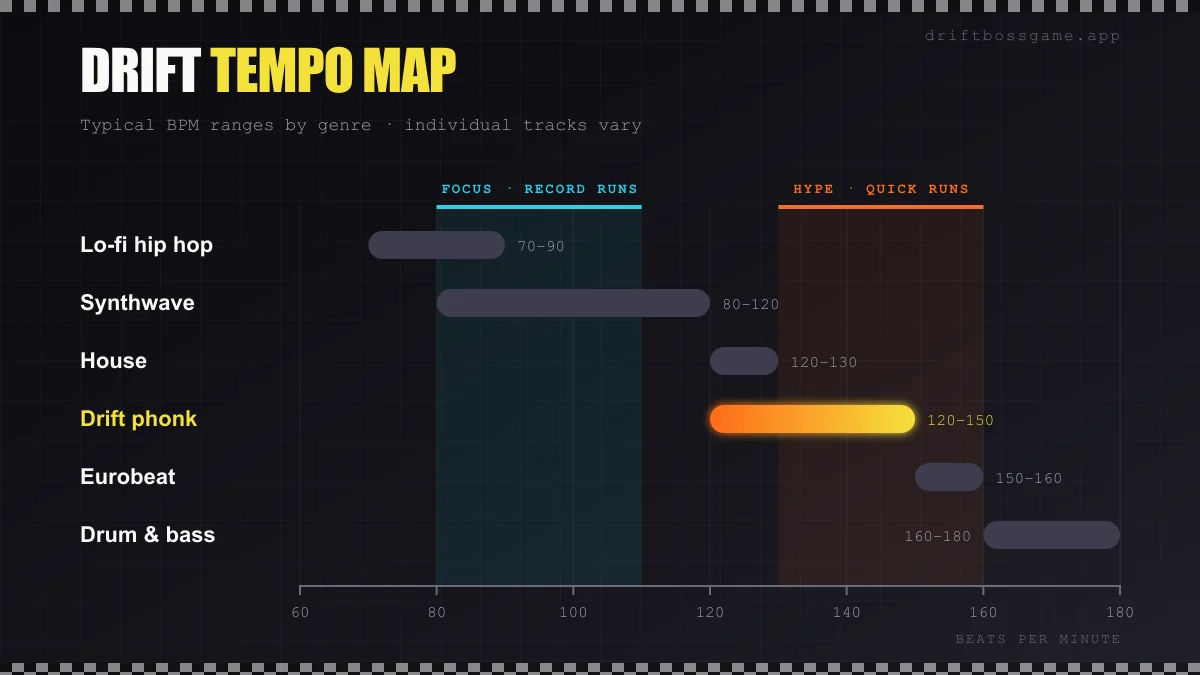
| Genre | Typical BPM | Best for | Watch out for |
|---|---|---|---|
| Lo-fi hip hop | 70–90 | Long record attempts | Can feel sleepy in short sessions |
| Synthwave | 80–120 | Steady, focused runs | Big builds and solos in some tracks |
| House | 120–130 | Warm-up runs | Breakdowns that drop the beat |
| Drift phonk | 120–150 | Short, aggressive sessions | Loud drops, so mind the volume |
| Eurobeat | 150–160 | Pure hype, Initial D vibes | Fast tempo can make you rush |
| Drum & bass | 160–180 | Experienced players | Easy to over-tap |
A good rule of thumb: the longer you want a run to last, the slower and steadier the music should be. If you’re chasing a score worth comparing to the Drift Boss world record, calm beats keep your heart rate and your thumb under control. If you just want five quick runs on the bus, turn the energy up.
Playlists for Every Kind of Session
Record attempts
Instrumental lo-fi or mellow synthwave, roughly 80–110 BPM. No vocals, no drops, nothing that changes tempo halfway through. One long mix beats a shuffled playlist, because the gap between tracks is exactly where concentration slips.
Quick sessions on mobile
Drift phonk or Eurobeat. Runs are short, mistakes are cheap, and the energy makes hitting restart feel like part of the fun.
Warm-up and practice
House or upbeat electronic around 120–125 BPM. Steady enough to settle into a rhythm, lively enough that practice doesn’t feel like homework.
Seasonal runs
If you’re playing Drift Boss Pumpkin, the Halloween reskin, dark phonk suits the spooky look better than anything else.
The same approach works across our other drift games. Slower, more technical games like Drift Hunters pair well with synthwave, while pure arcade chaos calls for phonk.
Make Your Own Drift Soundtrack with AI
Streaming playlists have two problems. They’re full of tracks that almost fit, like a great loop ruined by a breakdown at the two-minute mark. And if you record your runs for TikTok or YouTube, commercial songs can trigger copyright claims.
An AI music generator solves both. Instead of hunting for the perfect track, you describe it. Tunora’s AI music generator turns a text prompt into an original song, with vocals or as an instrumental, and gives you two takes for every prompt so you can keep the better one.
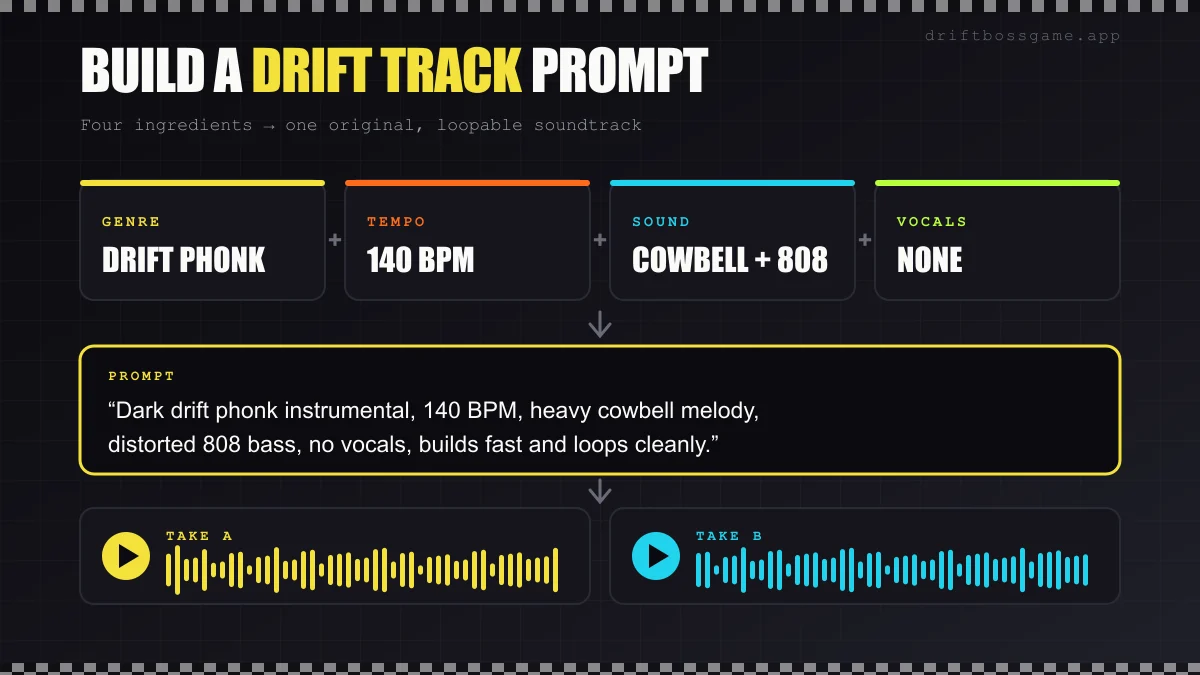
Here’s a simple recipe:
- Name the genre. “Drift phonk”, “dark synthwave” or “Eurobeat” gets you most of the way.
- Set the tempo. Use the BPM guide above: around 90 for record runs, 130–150 for hype sessions.
- Describe the signature sounds. For phonk, a cowbell melody and distorted 808 bass. For synthwave, analog synths and gated drums.
- Choose instrumental. For gameplay, no vocals is almost always the better call.
- Ask for something loop-friendly. Words like “steady”, “no breakdown” and “loops cleanly” help.
A few prompts to start with:
- Record-run focus: “Mellow lo-fi synthwave instrumental, 90 BPM, warm analog pads, soft steady drums, no vocals, no drops.”
- Hype session: “Dark drift phonk instrumental, 140 BPM, heavy cowbell melody, distorted 808 bass, no vocals.”
- Retro drift: “High-energy Eurobeat instrumental, 155 BPM, bright synth leads, driving bassline, early-2000s arcade feel.”
If you plan to use a generated track in videos you monetize, check the license that comes with your plan first. Free and paid tiers on AI music tools, Tunora included, come with different usage rights.
Final Lap
There’s no single correct Drift Boss soundtrack, and some of the best players still run in total silence. If you do want music, match it to the session: calm, steady instrumentals for long runs, drift phonk or Eurobeat when you just want to throw the car into corners. When no playlist quite fits, make a track that does.
Then put your headphones on and play Drift Boss.
Play Drift Boss free in your browser. No download, no signup.